2013 Dr. Jean Mayer Award Recipients

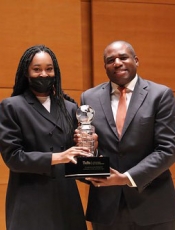
Bonnie Jenkins

Ambassador Jenkins, the State Department Coordinator for Threat Reduction Programs, served as the Chair of the Global Partnership Against the Spread of Weapons and Materials of Mass Destruction in 2012 and will continue her role as U.S. representative to the GP in 2013. She is the Department of State lead on the Nuclear Security Summit, and she coordinates the Department of State’s activities related to the four-year effort to secure all vulnerable nuclear material. Ambassador Jenkins coordinates Department of State Cooperative Threat Reduction (CTR) programs and helps to ensure a coordinated approach when promoting these programs internationally. Ambassador Jenkins also promotes international dialogue among the public health and security communities in the area of Global Health Security, including the enhancement of global preparedness and intersectoral partnerships to prevent, reduce and respond to high-impact biological threats. Ambassador Jenkins also promotes the funding of activities in the area of chemical security.

Prior to rejoining the U.S. Government, Ambassador Jenkins most recently served as the Program Officer for U.S. Foreign and Security policy at the Ford Foundation. Her grant-making responsibilities sought to strengthen public engagement in U.S. foreign and security policy debate and formulation, promoting support for multilateralism, the peaceful resolution of disputes, and the international rule of law. Prior to joining the Foundation, Ambassador Jenkins served as counsel on the National Commission on Terrorist Attacks upon the United States, more commonly known as the "9-11 Commission." She was the lead Commission staff member on counterterrorism policy in the Office of the Secretary of Defense and on U.S. military plans targeting al Qaeda prior to 9-11.

Ambassador Jenkins also served as General Counsel to the U.S. Commission to assess the organization of the Federal Government to combat proliferation of weapons of mass destruction, and as a consultant to the 2000 National Commission on Terrorism. Additionally she worked at the RAND Corporation in their National Security Division. A retired Naval Reserve officer, she completed a year-long deployment to U.S. Central Command (CENTCOM). She has received numerous awards in her time as an officer in the U.S. Naval Reserves. Ambassador Jenkins is an expert on arms control and nonproliferation of weapons of mass destruction, and she served for nine years as legal advisor to U.S. Ambassadors and delegations negotiating arms control and nonproliferation treaties during her time as a legal advisor in the Office of General Council at the U.S. Arms Control and Disarmament Agency. She has been a legal advisor on the Comprehensive Nuclear Test Ban Treaty (CTBT), the Chemical Weapons Convention, and the Conventional Forces in Europe Treaty among others. She also served as U.S. legal advisor on relevant treaty implementing bodies, such as the CTBT Organization (CTBTO), and the Organization for the Prohibition of Chemical Weapons (OPCW).

Ambassador Jenkins has been an adjunct professor at Georgetown University Law School. She was a fellow at the Belfer Center for Science and International Affairs at the John F. Kennedy School of Government, Harvard University. During her years at Belfer, she served as an advisor at Harvard Law School’s Bernard Koteen Office of Public Interest Advising. Ambassador Jenkins has a Ph.D. in International Relations from the University of Virginia; an LL.M. in International and Comparative Law from the Georgetown University Law Center; an M.P.A. from the State University of New York at Albany; a J.D. from Albany Law School; and a B.A. from Amherst College. She also attended The Hague Academy for International Law.

Irwin Rosenberg

University Professor and the Jean Mayer Professor of Nutrition at the Friedman School, Irwin Rosenberg is the 2006 recipient of the Conrad Elvehjem Award for Public Service in Nutrition, which recognizes distinguished service to the public through nutrition science. He received the award from the American Society of Clinical Nutrition in April at the 2006 Experimental Biology Meeting in San Francisco. Throughout his career, Rosenberg has participated in many national and international nutrition policy efforts and has held positions on committees for the Food and Drug Administration and the Institute of Medicine. Since joining Tufts, Rosenberg has served as dean of the Friedman School for nine years and director of the HNRCA for 15 years. Currently, Rosenberg directs the Nutrition and Neurocognition Laboratory at the HNRCA. Dr. Rosenberg’s research interests include nutrition and aging; folate nutriture; and the relationship between homocysteine, B vitamin nutriture, vascular disease and cognitive decline.

Médecins Sans Frontières (MSF)

Médecins Sans Frontières (MSF) is an international, independent, medical humanitarian organisation that delivers emergency aid to people affected by armed conflict, epidemics, natural disasters and exclusion from healthcare. MSF offers assistance to people based on need, irrespective of race, religion, gender or political affiliation. MSF’s actions are guided by medical ethics and the principles of neutrality and impartiality. MSF reserves the right to speak out to bring attention to neglected crises, to challenge inadequacies or abuse of the aid system, and to advocate for improved medical treatments and protocols.

Bernard Lown

Dr. Bernard Lown is Professor of Cardiology Emeritus at the Harvard School of Public Health, Senior Physician at Brigham and Women's Hospital in Boston, and the Founder of the Lown Cardiovascular Center and Lown Cardiovascular Research Foundation. Dr. Lown developed the direct current defibrillator for resuscitating the arrested heart as well as the cardioverter for correcting disordered heart rhythms. In 1962, he cofounded the Physicians for Social Responsibility (PSR) and became its first president. From 1974 to 1975, he presided over the USA-China Physicians Friendship Association, and served as coordinator of collaborative studies with the USSR on cardiovascular disease on behalf of the National Heart and Lung Institute. In 1980, he cofounded the International Physicians for the Prevention of Nuclear War (IPPNW). Drs. Lown and Chazov served as IPPNW’s first Co-Presidents, and in 1985, they were co-recipients of the Nobel Peace Prize on behalf of IPPNW. Dr. Lown is also the recipient of the UNESCO Peace Education Prize (with Dr. Chazov), the George F. Kennan Award, the Ghandi Peace Prize, and the first Cardinal Medeiros Peace Award, as well as 20 honorary degrees from leading universities both in the USA and abroad. Dr. Lown is the founder and emeritus Chairman of SATELLIFE, an international non-profit organization that uses satellite and Internet technologies to serve the health communication and information needs of developing countries. Dr. Lown is the founder of ProCor, an ongoing, worldwide, e-mail- and web-based electronic conference that addresses the emerging epidemic of cardiovascular diseases in the developing world.


Mary Kaldor

Mary Kaldor (born 16 March 1946) is a British academic, currently Professor of Global Governance at the London School of Economics, where she is also the Director of its Centre for the Study of Global Governance. She has been a key figure in the development of cosmopolitan democracy. She writes on globalisation, international relations and humanitarian intervention, global civil society and global governance, as well as what she calls New Wars. Before the LSE, Kaldor worked at the Stockholm International Peace Research Institute (SIPRI) and now serves on its governing board. She also worked at the Science Policy Research Unit at the University of Sussex, where she worked closely with English economist Christopher Freeman. She was a founding member of European Nuclear Disarmament, editing its European Nuclear Disarmament Journal (1983–88). She was the founder and Co-Chair of the Helsinki Citizens Assembly, and a founding member of the European Council on Foreign Relations. She also writes for OpenDemocracy.net, and belongs to the Board of Trustees of the Hertie School of Governance.


Anne Goldfeld

Anne E. Goldfeld is Professor of Medicine at Harvard Medical School, Professor of Immunology and Infectious Diseases at Harvard School of Public Health, Senior Investigator in the Program in Cellular and Molecular Medicine, Children’s Hospital Boston, Physician in the Division of Infectious Disease at Brigham & Women’s Hospital, and President and Co-Founder of the Global and Cambodian Health Committees. Work in her laboratory has provided groundbreaking insights into the function and regulation of the innate immune system at the molecular level, in particular the transcriptional control of the tumor necrosis factor (TNF) gene. Her work on the pathogenesis of HIV and M. tuberculosis infection has led to the discovery of the first gene associated with TB and regulatory T cells in infectious disease. Dr. Goldfeld’s clinical work in Cambodia has focused on developing approaches of community-based care for TB and HIV while nesting scientific studies in these delivery networks leading to new international standards of care and to fundamental medical discoveries aimed at developing new therapies. More recently, she and her colleagues have turned their attention to combating drug resistant TB and providing access to drugs in Ethiopia by spearheading the initiation of care for drug resistant TB in that country with its ministry of health. Dr. Goldfeld’s humanitarian work has focused on advocacy and bringing care to those in most need. She was at the origin of global efforts to ban landmines making the first call for an international ban on landmines in 1991 in congressional testimony. She provided some of the earliest evidence of gender-based violence against women in situations of war and torture in 1988. She served as medical coordinator at the Site II refugee camp for the American Refugee Committee’s program on the Thai-Cambodian border in 1989 and in 1994 she co-founded the Cambodian Health Committee, which has also been known as the Global Health Committee since 2008. She worked as a doctor in the Mugunga refugee camp in eastern Congo during the aftermath of the Rwandan genocide, and has provided assistance or participated in missions to Albania/Kosovo, Pakistan, Afghanistan, Angola, Swaziland, Dharamsala/Tibet, Guatemala, Bolivia and Peru. In addition to her scientific publications, her writing has appeared in the New York Times, the Washington Post, The Nation, the International Herald Tribune, the Los Angeles Times and the Boston Globe. She is co-author of the book Beyond Hiroshima.

Laurie Garrett

Since 2004, Laurie Garrett has been a senior fellow for global health at the Council on Foreign Relations (CFR) in New York. Ms. Garrett is the only writer ever to have been awarded all three of the Big "Ps" of journalism: the Peabody, the Polk, and the Pulitzer. Her expertise includes global health systems, chronic and infectious diseases, and bioterrorism. Ms. Garrett is the best-selling author of The Coming Plague: Newly Emerging Diseases in a World Out of Balance (Farrar, Straus, and Giroux, 1994) and Betrayal of Trust: The Collapse of Global Public Health (Hyperion Press, 2000). During her PhD studies, she started reporting on science news at KPFA, a local radio station.  At KPFA, Ms. Garrett worked on a documentary, coproduced with Adi Gevins, that won the 1977 George Foster Peabody Award. After leaving KPFA, Ms. Garrett worked briefly in the California Department of Food and Agriculture, assessing the human health impacts of pesticide use. In 1980, she joined National Public Radio, working out of the network's San Francisco and, later, Los Angeles bureaus as a science correspondent.  In 1988, Ms. Garrett left NPR to join the science writing staff of Newsday. Her Newsday reporting has earned several awards, including the Newsday Publisher's Award (Best Beat Reporter, 1990), Award of Excellence from the National Association of Black Journalists (for "AIDS in Africa," 1989), Deadline Club of New York (Best Beat Reporter, 1993), First Place from the Society of Silurians (for "Breast Cancer," 1994), and the Bob Considine Award of the Overseas Press Club of America (for "AIDS in India," 1995). 


Jason Clay (WWF)

Jason Clay is the senior vice president of market transformation for the World Wildlife Fund. His goal is to create global standards for producing and using raw materials, particularly in terms of carbon and water. His ideas are changing the way governments, foundations, researchers, and NGOs identify and address risks and opportunities for their work. He brings people together to improve environmentally sensitive practices in agriculture and aquaculture. He has convened industry roundtables of retailers, buyers, producers and environmentalists to reduce the key impacts of producing soy, cotton, sugarcane, salmon, shrimp, mollusks, catfish and tilapia. Prior to joining WWF in 1999, he ran a family farm, taught at Harvard and Yale, worked at the U.S. Department of Agriculture and spent more than 25 years working with human rights and environmental organizations. Jason, in addition to authoring numerous books on subjects including World Agriculture and the Environment (2004) and Exploring the Links Between International Business and Poverty Reduction (2005), is Founder and Editor of Cultural Survival Quarterly, winner of UTNE reader award for best publication with circulation of less than 30,000, best publication for international news and analysis, and best coverage of international cultural issues.

Svetlana Broz

Svetlana Broz is a Yugoslavian author and physician who specializes in cardiology. Born in 1955, Broz is the youngest child of Žarko Leon Broz, Tito's eldest son, and Zlata Jelinek-Broz. She worked as a free-lance journalist from 1970 to 1975; many of her articles and interviews were published in newspapers and magazines. She graduated from the Belgrade Medical School in 1980 and has served as a cardiologist at the Military Medical Academy (VMA) from 1981 to 1999, and volunteered her services at the outbreak of the war in Bosnia and Herzegovina in 1992. Her new project is about inter-ethnic marriages entered into during the war. In 2004, she became a citizen of Bosnia-Herzegovina. Broz is currently heading the local branch of the Gardens of the Righteous Worldwide (GARIWO) non-governmental organization. She is the founder of "Education Towards Civil Courage", a series of seminars designed to teach adolescents from all over the Balkans how to stand up to corruption and social and political divisiveness. In the summer 2007, the organization will begin the research and preparation phase for the foundation of a Center for Civil Courage in Bosnia-Herzegovina.

Uche Amazigo

Uche Veronica Amazigo is an experienced international scientist and administrator, with extensive expertise in international and community health, public-private partnership, research and policy and strategy development. Trained in public health and parasitology, specializing in tropical diseases and reproductive health, Dr. Amazigo was formerly senior lecturer in medical parasitology and public health at the University of Nigeria. Her research experience encompasses adolescent reproductive health, strategies for controlling neglected tropical diseases and community-directed health interventions (CDI). Her interest in gender and onchocerciasis (river blindness) led to her pioneering research that formed the scientific basis for establishing APOC in 1995, succeeding the Onchocerciasis Control Programme in West Africa. Her distinguished career culminated in her appointment as APOC Director in 2005. Currently, she is engaging 117,000 communities, 19 African governments, 14 civil societies and numerous donors using community participation to bring multiple health interventions to areas beyond the reach of health care services in stable and fragile countries.

2012 to 2013 Dr. Jean Mayer Award Recipients

Susannah Sirkin

Susannah Sirkin is Deputy Director at Physicians for Human Rights, a position she has held since 1987 when she joined PHR shortly after its founding. She has helped lead PHR's campaigns against Persecution of Health Workers, including the current efforts to free the Alaei brothers, two Iranian doctors with expertise in HIV/AIDS treatment who are imprisoned in Tehran on false charges. Susannah has organized health and human rights investigations to dozens of countries, including recent documentation of genocide and systematic rape in Darfur, Sudan; PHR's exhumations of mass graves in the former Yugoslavia and Rwanda for the International Criminal Tribunals; investigations into consequences of human rights abuses and violations of international humanitarian law in Afghanistan, El Salvador, Haiti, India, Iraq, Israel/Palestine, Kosovo, Kuwait, Somalia, Turkey and the US among others. She has worked on studies of sexual violence in Bosnia, Sierra Leone, and Thailand, and authored and edited numerous reports and articles on the medical consequences of human rights violations, physical evidence of human rights abuses, and physician complicity in violations.

Jonathan Moreno

Jonathan D. Moreno is a Senior Fellow at American Progress, where he edits the magazine, Science Progress. He is one of 13 Penn Integrates Knowledge university professors at the University of Pennsylvania. He is also professor of medical ethics and health policy, of history and sociology of science, and of philosophy. In 2008-09 he served as a member of President Barack Obama’s transition team. Moreno is an elected member of the Institute of Medicine/National Academy of Sciences and is a national associate of the National Research Council. He has served as a senior staff member for three presidential advisory commissions, including the current bioethics commission under President Obama, and has given invited testimony for both houses of Congress. He is a member of the Governing Board of the International Neuroethics Society, a faculty affiliate of the Kennedy Institute of Ethics at Georgetown University, a fellow of the Hastings Center and the New York Academy of Medicine, and a past president of the American Society for Bioethics and Humanities. He advises various science, health, and national security agencies and serves as a member of the Defense Intelligence Agency’s TIGER committee on potentially disruptive novel technologies.

Izzeldin Abuelaish

Dr. Izzeldin Abuelaish, MD, MPH, is Palestinian medical doctor who was born and raised in the Jabalia refugee Camp is a passionate and eloquent proponent of peace between Palestinians and Israelis. Before his three daughters were killed in January 2009 during the Israeli incursion into Gaza, Dr. Abuelaish worked as a researcher at the Gertner Institute at the Sheba Hospital in Tel Aviv. Abuelaish has been an important figure in the Israeli-Palestinian relations for years, working in Israeli hospitals, treating Israeli and Palestinian patients and fully believe that health is an engine for the journey to peace. This horrific tragedy did not harden Abuelaish’s heart; neither did it weaken his resolve to act for humanity. He continues to live up the description bestowed upon him by an Israeli colleague, as a magical, secret bridge between Israelis and Palestinians.Dr. Izzeldin Abuelaish currently is Associate Professor of Medicine at the Dalla Lana School of Public Health; University Of Toronto. He has been invited to give speeches in The European Parliament, Belgian Parliament, House of Commons, the American Congress, state department, Forum 2000 in Prague. In addition, he has given speeches all over the world in academic institutions, Universities and organizations in Canada, USA and Europe.

2005 to 2013 Dr. Jean Mayer Award Recipients

Gwyn Prins

Dr. Prins is a research professor at the European Institute of the London School of Economics and Political Science. He was the First Alliance Professor appointed jointly at the LSE and the Columbia Earth Institute. He has also taught in the Department of History and the School of International and Public Affairs at Columbia University. He is a Senior Fellow in the Office of the Secretary-General of NATO in Brussels and a Visiting Senior Fellow in the Defence, Science and Technology Laboratory of the UK Ministry of Defence, as well as a consultant on security at the Hadley Centre for Climate Prediction and Research of the British Meteorological Office. In 1999-2000, he chaired an MoD Chatham House study group on the roots of asymmetric violence and contemporary terrorism. He is a member of the Pugwash Working Groups on Nuclear Weapons in the 21st Century and on the International Commission on Intervention and State Sovereignty. He is the coeditor of The Future of War and the author of Understanding Unilateralism in American Foreign Relations and The Heart of War.

2003 to 2013 Dr. Jean Mayer Award Recipients

James Nachtwey

James Nachtwey grew up in Massachusetts and studied Art History and Political Science in college. Images from the Vietnam War and the American Civil Rights movement had a powerful effect on him and were in- strumental in his decision to become a photographer. His first foreign assignment was to cover civil strife in Northern Ireland in 1981 during the IRA hunger strike. Since then, Nachtwey has devoted himself to documenting wars, conflicts and critical social issues. He has worked on extensive photographic essays in El Salvador, Nicaragua, Guatemala, Lebanon, the West Bank and Gaza, Israel, Indonesia, Thailand, India, Sri Lanka, Afghanistan, the Philippines, South Korea, Somalia, Sudan, Rwanda, South Africa, Russia, Bosnia, Chechnya, Kosovo, Romania, Brazil and the United States. Nachtwey has been a contract photographer with Time Magazine since 1984. He has received numerous honors such as the Robert Capa Gold Medal (five times), the World Press Photo Award twice, Magazine Photographer of the Year (six times), the International Center of Photography Infinity Award three times, the Leica Award twice, the Bayeaux Award for War Correspondents (twice), the Alfred Eisenstaedt Award, the Canon Photo essayist Award and the W. Eugene Smith Memorial Grant in Humanistic Photography.